Finding information is the easy bit. Deciding whether to believe it is where beginners come unstuck. A five-question checklist, how fact checkers read “sideways”, the grading scales used by UK policing and NATO, and a fictional viral rumour traced back to where it started.

Photo: Utsav Srestha / Unsplash
Source evaluation asks two questions.
A reliable source can be wrong on the day: a national newspaper misreading a court listing. An unknown account can post something true. UK policing grades the two on separate scales.
OSINT (open-source intelligence) turns public material into something a decision-maker can act on. Your report is only as defensible as your worst source.
In a Stanford study, professional fact checkers reached better-founded judgements than historians and students, and faster. They glanced at a page, then checked what the rest of the web said about its publisher. This is lateral reading.
One fictional case runs through the steps: a viral post about Harrowgate Freight Ltd, a haulage firm that does not exist.
Step 1: Stop. Mike Caulfield’s SIFT method starts here: Stop, Investigate the source, Find better coverage, Trace claims to the original context. Open a new tab, not the share button.
Step 2: Read laterally. Search for the publisher, not the claim:
"northern-haulage-news.example" -site:northern-haulage-news.exampleQuotation marks match an exact phrase, the minus sign excludes a term, and site: limits results to one domain, so -site: hides the site’s own pages. For our fictional site, only its own social accounts turn up.
Step 3: Ask the five questions. Applied to the fictional article:
Step 4: Grade it and word it carefully.
The two grading systems run the opposite way round (police number the source, NATO letters it), so name the scale you are using.
The viral post claims Harrowgate Freight “has gone into administration, drivers unpaid”, with a screenshot from northern-haulage-news.example. It has 1,200 reposts.
We stop. We trace the three blogs to one article: one claim repeated, not four sources. We read laterally and find nobody else mentioning the publisher. We find the original: a forum account two days old, with no other activity. Then we check the primary records. Companies House registers company information and makes it public; The Gazette carries formal insolvency notices, including administrator and liquidator appointments. Neither shows anything.
Our log entry reads: “Source 2, information D. It is unlikely that Harrowgate Freight has entered administration. Low confidence. Checked Companies House and The Gazette on 23 September 2026, nothing found. Re-check 25 September.” Absence is not proof, so we show our working: what we checked, and when.
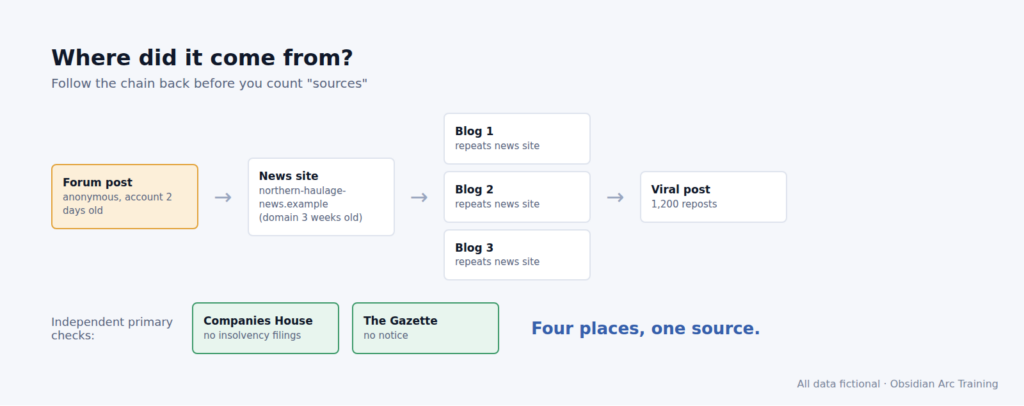
Figure: OAT teaching graphic. Fictional data.
The OAT view Collection is the easy bit. The professional standard is saying how far you trust a source, why, and what you checked. If your grading would not survive a colleague’s questions, it is not defensible.
Print the top tips sheet and try the five questions on the next post you see.
Stick to public information. If a source leads to personal data, UK GDPR and the Data Protection Act 2018 apply: have a clear purpose and collect only what is proportionate. Never access an account or system without authorisation to “check” a claim; that is Computer Misuse Act 1990 territory. Logging into the drivers’ forum on someone else’s account to see who posted would cross that line.
OSINT is easy to start and hard to do properly. We teach the hard part. Grading and confidence wording are core to the course. Find out about our Level 3 Award in OSINT at obsidianarctraining.com.

